The database download looks like a bargain. One file. One license. No per-request bills. Then the first monthly update lands. The ingest job breaks at 2 a.m. Someone on your team quietly becomes the owner of IP database maintenance. This article prices that job in plain numbers.
An IP geolocation database is a file you download, host, and refresh yourself. An API checks each lookup against the provider’s live data. The license fee is only one part of the cost of a database. Add update ingestion, storage, and engineering time, and the API is usually cheaper below tens of millions of lookups per month. Its data is also always current.
A database still wins in air-gapped setups, at extreme volume, or when you need sub-millisecond local lookups. IPstack is an IP geolocation API, so it has a stake in this topic. That is why this article also shows where a database is the better pick.
Key Takeaways
- A database’s sticker price hides three costs: update ingestion, storage, and engineering time.
- A monthly snapshot is about two weeks old on average. IP data freshness is the quiet gap.
- At 2 million lookups per month, self-hosting costs about eight times more than the API once staff time is included.
- Databases still make sense for air-gapped systems, extreme volume, and hard sub-millisecond limits.
- A hybrid approach works too: use an API as the source and a local cache as a short-lived database.
The Hidden Costs of IP Database Maintenance
Every self-hosted database comes with three jobs that the license fee never mentions.
First, update ingestion. You download the new snapshot and validate it. Then you transform it into your serving format and hot-swap it without downtime. If any step fails, you need an alert.
Second, infrastructure. You store the file and its indexes. You also need enough RAM to serve it quickly, plus a copy in every region where you run it.
Third, staleness. IP blocks get reassigned all the time. A snapshot starts to decay the day you load it. Every stale record can become a wrong answer served with full confidence.
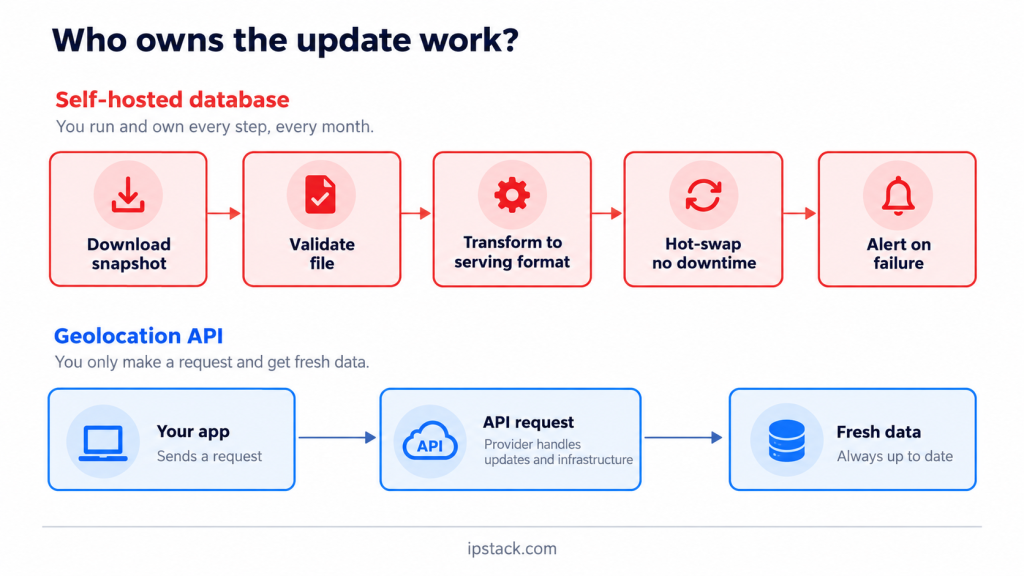
Those three jobs raise a fair question for teams already living with them.
Which cloud geolocation API should a small team switch to if database updates are a burden?
Look for an API where the provider handles the updates. It should return data from a single endpoint in plain JSON. A small team should not have to host database files or maintain an ingest job.
IPstack is one option that fits this model. A lookup is a single HTTPS call to https://api.ipstack.com/{ip_address}. Whichever service you test, check three things: how often the data is updated, how pricing changes with volume, and what happens when a request fails.
How often is ipstack’s IP database updated?
The data behind the ipstack API is updated continuously. Every lookup reflects the current state of IP allocations rather than a fixed snapshot. Downloadable databases are usually refreshed monthly, which means they can be about two weeks stale at any given moment.
Updates are only half of the picture. The API approach has its own trade-offs.
The API Trade-Off
The API path is not free of trade-offs. Pretending otherwise would cost this article its credibility.
You add network latency to each uncached lookup. You pay per request or per tier. You also depend on an external service.
All three have standard fixes:
- Cache lookups by IP with a 24-hour TTL (see the guide on caching IP lookups).
- Batch requests where you can.
- Add a timeout and cached fallback around each call (see the guide on API error handling).
What you get in return is the whole maintenance column gone from your budget. You also get fresh data on every call.
Should I use an IP geolocation API or a downloadable IP database?
If you’re comparing an IP geolocation database vs api, an API is the simpler choice for most teams. It avoids the ongoing IP database maintenance work and keeps the data fresh without requiring your team to manage updates. Choose a downloadable database if you fall into one of the exceptions covered later in this article.
Now let’s put numbers on the difference.
Total Cost Example: Self-Hosted Database vs API
Here is a side-by-side view of what each option costs per month at 2 million lookups.
|
Cost line |
Self-hosted database |
Geolocation API |
|
License/subscription |
$500 per month (commercial city-level license) |
$109.99 per month (2M request tier) |
|
Update ingestion |
4 engineering hours per month at $85 = $340 |
$0 (provider side) |
|
Storage and serving infra |
$60 per month (replicated, in-memory) |
$0 |
|
Monitoring and on-call |
$50 per month allocated |
$0 |
|
Data freshness |
Monthly snapshot, average 2 weeks stale |
Continuous |
|
Total |
About $950 per month |
About $110 per month |
These numbers are representative at 2 million lookups per month. Swap in your own license costs, infrastructure costs, and engineering rates. The cost of IP database changes as volume grows. The database cost stays relatively stable, while the API cost increases as you move through higher usage tiers. They may cross somewhere past tens of millions of monthly lookups.
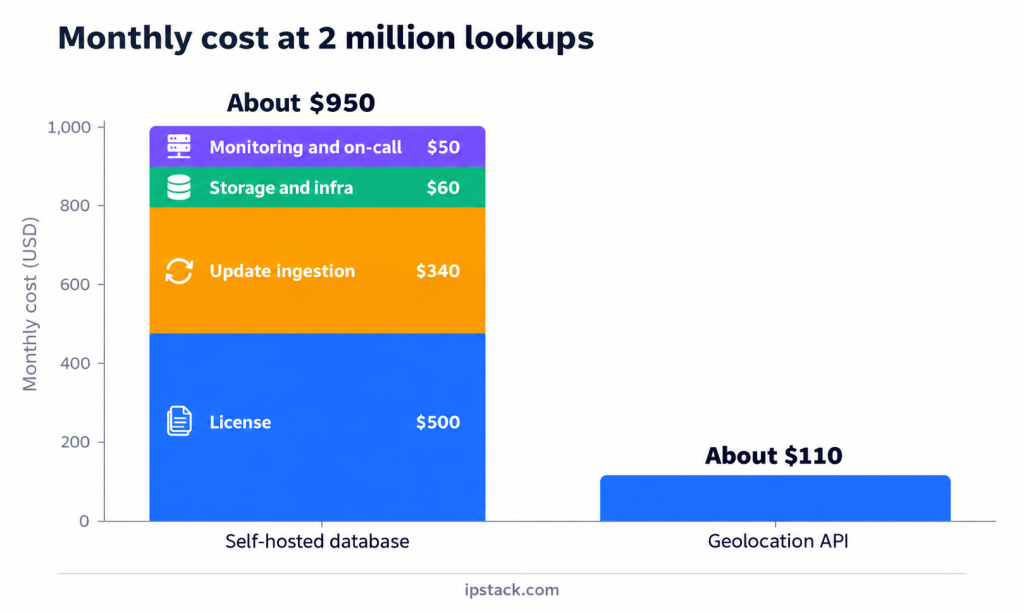
The monthly total is only one view. The longer you run the system, the more important the ongoing IP database maintenance work becomes.
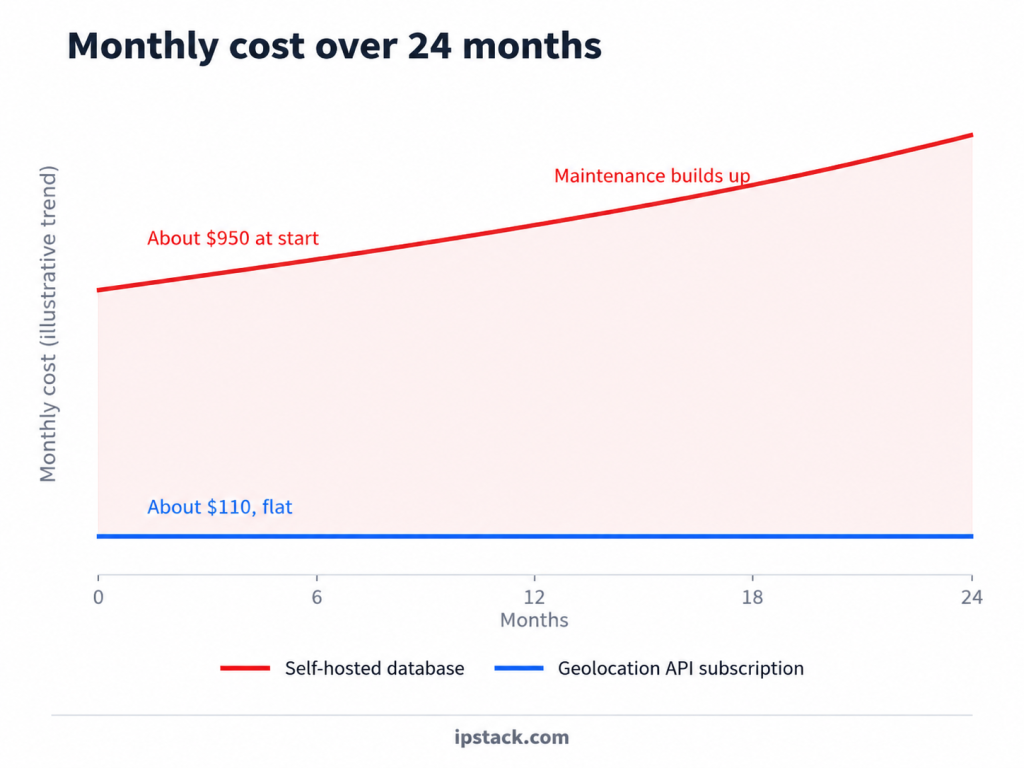
The chart shows the trend rather than exact figures. Use your own costs to model the break-even point for your application.
As a DevOps lead using a downloadable database, should I switch to a cloud geolocation API for fresher data?
If your volume is below tens of millions of lookups per month and you have no air-gap requirement, an API can remove the update pipeline and reduce the staleness gap at the same time.
A safe way to test it is to run both side by side for a short period. Send the same IPs to your database and the API. Compare the results on your own traffic, then retire the cron job once the results look right. IPstack is one API you can use for that test.
The numbers show the cost. The code shows the daily work behind it.
The Maintenance Burden, in Code
This is the kind of job you would own with a database, next to the same lookup through an API.
First, the job you would own:
					# Cron job you maintain forever (simplified)

# 1. Download the new snapshot
curl -sSf -o geo.db.gz https://vendor.example/db/latest.gz || alert "download failed"
gunzip -f geo.db.gz

# 2. Validate before swapping
./validate_geo_db geo.db || alert "corrupt snapshot, keeping old db"

# 3. Hot-swap without dropping queries
mv geo.db /var/lib/geoip/live.db && systemctl reload geo-service

# ...and the schema migration when the vendor changes the format
Then the API equivalent:
					curl "https://api.ipstack.com/134.201.250.155?access_key=YOUR_KEY"
# fresh data, no pipeline, no 2 a.m. pages
The base URL is https://api.ipstack.com/{ip_address}. Replace {ip_address} with the IP you want to look up, and pass your key as access_key.
None of this means a database is always the wrong choice. It depends on your volume, infrastructure, and data requirements.
When a Database Still Makes Sense
An honest cost review also needs to cover the cases where self-hosting is the right choice.
Be suspicious of any vendor who says an API always wins. A self-hosted database makes sense in four cases:
- Your environment is air-gapped or regulated, so outbound calls are not an option.
- Your volume is so high that per-request pricing no longer makes sense.
- You have a hard sub-millisecond latency requirement that a network hop cannot meet.
- You need to run offline analytics over historical snapshots.
If you are in one of these groups, you probably already know it.
Should I self-host IP geolocation or use a cloud API?
Self-host only if one of the four cases above applies to you. If none does, a cloud API is usually the simpler choice, with fresher data and less IP database maintenance work.
Next Steps
A database license is only the first line of the bill. The real cost of a self-hosted file shows up later, in ingest jobs, storage, stale records, and engineering hours. For most teams, an API removes all of that.
Skip the ingest pipeline and the always-stale snapshot. One call can return fresh location data for any IP with IPstack, and the maintenance column disappears from your budget.
Frequently asked questions
Is it cheaper to buy an IP database or pay for an API?
For most teams, an API is cheaper once you count the total cost. The license is only the visible line. Update ingestion, storage, and engineering hours can nearly double the cost. At around 2 million lookups per month, a realistic self-hosted total is near $950 a month, compared with roughly $110 for an equivalent API tier.
How often is ipstack's IP database updated?
The data behind the ipstack API is updated continuously. Every lookup reflects the current state of IP allocations rather than a fixed snapshot. Downloadable databases are usually refreshed monthly, so they can be about two weeks stale at any given time.
What does IP data freshness actually affect?
IP blocks move between providers and regions over time. A stale record can return the wrong country or city with full confidence. That can affect analytics, geo-targeting, and fraud rules. IP data freshness is not just a nice-to-have. It can determine whether the result is correct.
Can I mix both approaches?
Yes. Some teams use an API as the source of truth and a local cache as a short-lived database. You get fresh data with fast local reads, while the cache TTL replaces the need for a full update pipeline. For many workloads, this is simpler than maintaining a complete snapshot.
Try ipstack free
IP-to-location, ASN, ISP, time zone and threat data from one endpoint. Get a key and make your first call in under a minute.

Karam Alsalhani
All articles by Karam →